Finite Element Multidisciplinary Analysis, Second Edition

Analysis of a structural system involves computation of deformations and stresses due to externally applied forces such as mechanical and thermal loads, the magnitudes of which are indicators of a safe design. This analysis in the present context involves first a finite element discretization of the continuum, e.g., for a static problem, resulting in a set of simultaneous algebraic equations that can be solved to yield the required unknown variables. The relevant analysis procedure is composed of the following basic steps:
Idealize the continuum as a set of smaller regions known as finite elements.
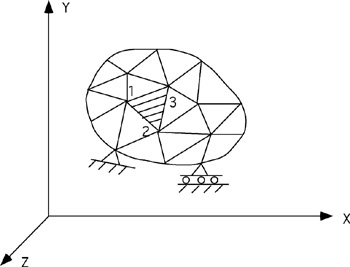
Select nodes at interelement boundaries and element interiors for the purpose of setting up of interpolating functions (see Fig. 3.1).
Figure 3.1: Finite element idealization.
Use interpolation functions to express displacement values at element interior points in terms of nodal variables.
Develop element force-displacement matrices by applying either the variational principles or the weighted residual method.
Assemble equilibrium matrices for the entire region in global coordinates for all of the element matrices, and solve the resulting set of algebraic equations for the unknown nodal values.
Calculate element stresses and strains from the calculated nodal displacements.
In the following chapters the analysis procedures will be presented in detail. First, however, some of the fundamental precepts of the theory of elasticity are set out followed by details of structural modeling and simulation procedures.
Materials in structural mechanics, either manufactured or occurring naturally, tend to exhibit complex patterns of behavior that may...