Finite Element Multidisciplinary Analysis, Second Edition
4.2: One-Dimensional Line Elements

4.2 One-Dimensional Line Elements

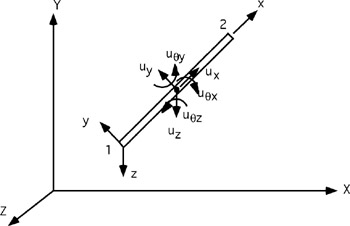
A one-dimensional beam element with six displacement degrees of freedom at each node is shown in Fig. 4.1. Structural characteristics of the straight element with uniform cross section A may be obtained from assumed axial, torsional, and flexural deformation components, combining these individual relationships as described next. [1] , [2] The local coordinate system is assumed such that the x axis corresponds to the axial direction of the element. The six displacement degrees of freedom at any point on the element are shown in Fig. 4.1.


Figure 4.1: One-dimensional line element.

Thus for the axial element the displacement interpolation in the local x direction assumes a linear relationship:


The coefficients c 1 and c 2 are evaluated in terms of nodal displacements by setting the boundary conditions u x = u x1 at x = 0 and u x = u x2 at x = l, so that


where N is the shape function row vector pertaining to the x direction. The strain is given by differentiation of u x with respect to x,


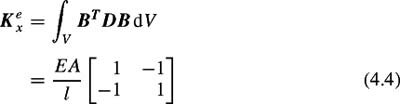
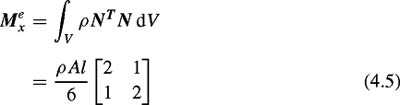
and the stiffness and inertia matrices are obtained as


using Eqs. (3.59) and (3.61) derived in Chapter 3. In these equations, E is the Young's modulus of elasticity, ? the mass density, A the area of the beam cross section, and l the length of the beam element.

For a...

UNLIMITED FREE
ACCESS
TO THE WORLD'S BEST IDEAS

SUBMIT
Already a GlobalSpec user? Log in.

This is embarrasing...

An error occurred while processing the form. Please try again in a few minutes.

Customize Your GlobalSpec Experience

Category: X-ray Sources
Finish!
Privacy Policy

This is embarrasing...

An error occurred while processing the form. Please try again in a few minutes.