Finite Element Multidisciplinary Analysis, Second Edition

4.5: Isoparametric Quadrilateral and Hexahedron Elements

4.5 Isoparametric Quadrilateral and Hexahedron Elements

4.5.1 Quadrilateral Element

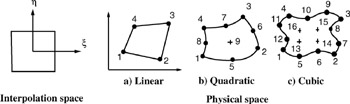
Having developed triangular elements in detail and showing how they may be combined to form quadrilateral elements of arbitrary shape, their direct formulation of isoparametric elements [13] , [14] will be discussed in this section. A family is shown in Fig. 4.13 in which the x, y coordinates are expressed in terms of curvilinear coordinates ?, ?. The quadratic and cubic elements may be interpolated using products of linear space Lagrange functions in which the presence of internal nodes is required. Alternatively it is possible to use the serendipity functions that have nodes embedded in the sides only. Development of the element stiffness and inertia matrices follows directly from the procedure adopted for the plane triangle and tetrahedron elements. The interpolation functions are given in ( ?, ?) space that spans (+1, ?1) in each coordinate direction, and the physical space is interpolated using the usual N shape functions,


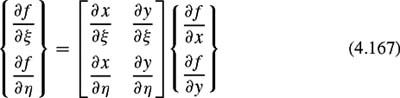
where N = N x = N y, and X contains columns of the x and y nodal coordinate values. Then the derivatives of any function f with respect to ?, ? are written in terms of x, y derivatives as


Figure 4.13: Planar quadrilateral isoparametric elements.

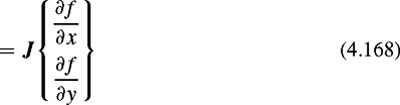
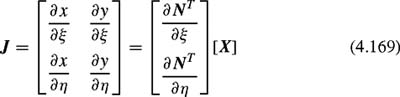
The preceding coefficient matrix is the Jacobian of the coordinate transformation and from Eq. (4.166) can be derived as


Inverting Eq. (4.168), the x

UNLIMITED FREE
ACCESS
TO THE WORLD'S BEST IDEAS

SUBMIT
Already a GlobalSpec user? Log in.

This is embarrasing...

An error occurred while processing the form. Please try again in a few minutes.

Customize Your GlobalSpec Experience

Category: Mesh Generators
Finish!
Privacy Policy

This is embarrasing...

An error occurred while processing the form. Please try again in a few minutes.