4.4.1 Constant Strain Tetrahedron
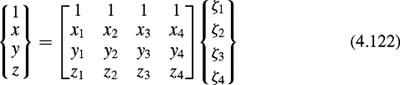
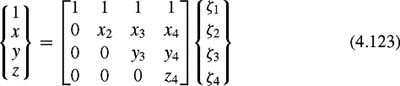
Figure 4.10 shows the natural coordinates system for a four-noded tetrahedron element with the face 1-2-3 on the local x- y plane. [11] , [12] The relationship between element local and natural coordinate systems may be expressed as
which, referring to Fig. 4.10, reduces to
 Figure 4.10: Four-noded tetrahedron and other solid elements.
 In the volume coordinate system ? i = V i/V, in which V i is the tetrahedron bound by the center of volume point P and surface opposite to the node i of the element. The volume V of the element is defined as
where
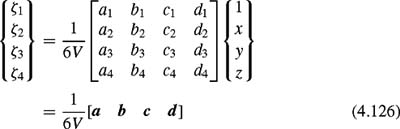
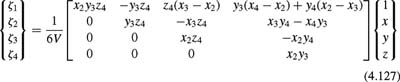
The inverse transformation of Eq. (4.103) is obtained as
or
A linear displacement distribution is assumed within the element. Thus typically
which with substitution of nodal boundary conditions yields
and similarly for u y and u z displacements, N y = N z = N x = N. Using the chain rule of differentiation, e.g., in the x direction for a function f
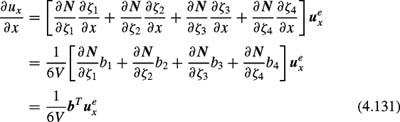
Now for f = u x, it follows that
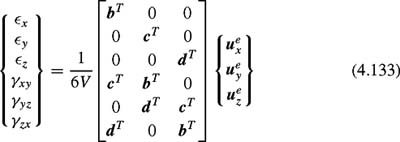
because ? N/ ? ? is a unit matrix of order four. Similar expressions can be obtained for other displacement derivatives. The strain-displacement relationships for the three-dimensional case are
which can be written in matrix form:
or
Then the stiffness matrix is given by
because B is constant. The inertia...

 TABLE OF CONTENTS