Finite Element Multidisciplinary Analysis, Second Edition

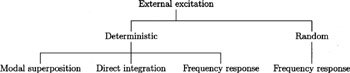
This chapter deals with the computation of the response of a structural system subjected to time-dependent dynamic loading. Usually the required response includes displacements and stresses. The choice of a relevant analysis technique is dictated by the nature of the external excitation shown in Fig. 10.1. For deterministic loading, when the forcing functions are known, the response is also deterministic and can be directly calculated either by the modal superposition method or by a step-by-step direct integration process. Associated external excitation may be general in nature, including periodic and aperiodic forcing functions.
In the modal superposition method any arbitrarily varying load function may be considered as a summation of a series of small loading steps and the response for the total force is taken as the cumulative response of the individual steps, which is permissible for any linear system. Response due to a small individual loading step can be calculated using Duhamel's integrals, which have been determined for a number of typical forcing functions. In the direct integration method, a step-by-step recurrence formulation is adapted for each incremental time step yielding a procedure that is capable of solving a variety of related linear and nonlinear problems. In the frequency response method, the system is characterized by its response to a simple forcing function that is harmonic in nature. This technique can be used for both deterministic as well as random excitation. In practice, random loads occur from a variety of...