Finite Element Multidisciplinary Analysis, Second Edition

4.7: Plate Bending Elements

4.7 Plate Bending Elements

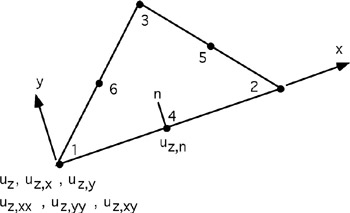
In a typical plate element the nodal unknowns consist of the transverse deflection u z and the nodal rotations ? x, ? y. The transverse deflection u z is expressed in a polynomial form and should satisfy compatibility conditions requiring continuity of u z, u ? x, and u ? y within the element. Also, the normal slope u z, n should be continuous across interelement boundaries if C 1 compatibility between elements is to be satisfied. Furthermore, the polynomial expansion must satisfy the rigid-body displacement state and reproduce a constant strain state. All of these conditions can be satisfied for a triangular element by selection of a complete quintic polynomial [15] , [16] in Fig. 4.18, in which nodal unknowns are as follows:

  • Nodes 1,2,3: u z, u z, x, u z, y, u z, xx, u z, yy, u z, xy

  • Nodes: 4,5,6: u z, n


Figure 4.18: Triangular plate bending elements using quintic interpolation displacement function.

It may be noted that, although u z has quintic variation within the element, its first derivative is quartic and its second derivative is cubic, all being continuous in nature. The slope normal to the interface, along a typical edge 1-2, u z, n, also has quartic variation and is uniquely defined by its values ( u 1 z, n, u 2 z, n, u 4 z, n

UNLIMITED FREE
ACCESS
TO THE WORLD'S BEST IDEAS

SUBMIT
Already a GlobalSpec user? Log in.

This is embarrasing...

An error occurred while processing the form. Please try again in a few minutes.

Customize Your GlobalSpec Experience

Category: Vacuum Gauges and Instruments
Finish!
Privacy Policy

This is embarrasing...

An error occurred while processing the form. Please try again in a few minutes.