Finite Element Multidisciplinary Analysis, Second Edition

Chapter 6: Dynamic Element Method

6.1 Introduction

In the usual finite element procedure, the continuous displacement field within an element is defined in terms of its unknown nodal displacement parameters by the fundamental relationship


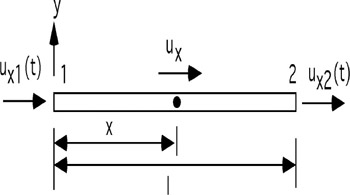
in which the matrix N represents the shape functions. Such a relationship, however, is strictly valid only for static loading since, for the general dynamic problem, N is not unique; it is then a function of the entire time history of the nodal displacements. In the special case of free vibration involving harmonic motion, Eq. (6.1) is valid when N is a function of the instantaneous nodal displacements and also of the frequency of such motion. The resulting stiffness and mass matrices are then obtained as functions of the frequency of the harmonic motion. [1] , [2] Thus, as an example, the equation of motion for a simple bar element in Fig. 6.1 has the following form:


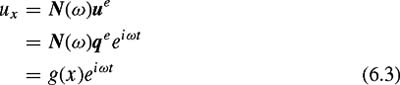
in which c 2 = E/ ?. The solution of Eq. (6.2) may be expressed as


where u e = [ u x1 u x2] T and q e = [ q x1 q x2] T. Substituting Eq. (6.3) into Eq. (6.2) yields


Figure 6.1: Bar element with time-varying nodal displacements.

The solution to Eq. (6.4) is


Using boundary conditions


the coefficients A and B are evaluated appropriately yielding the following expression for the shape function:


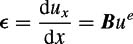
The strain displacement relations may then be obtained as


resulting...

UNLIMITED FREE
ACCESS
TO THE WORLD'S BEST IDEAS

SUBMIT
Already a GlobalSpec user? Log in.

This is embarrasing...

An error occurred while processing the form. Please try again in a few minutes.

Customize Your GlobalSpec Experience

Category: Control Valves
Finish!
Privacy Policy

This is embarrasing...

An error occurred while processing the form. Please try again in a few minutes.