Finite Element Multidisciplinary Analysis, Second Edition

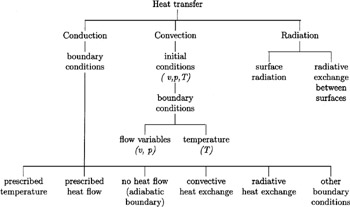
The process of heat transfer in a general medium may be categorized as conduction, convection, or radiation. In conduction, 1-3 transfer of thermal energy through a solid or fluid medium is caused by a temperature gradient between two locations that does not involve any material mass motion. The transfer of this thermal energy through a fluid because of motion of the fluid is known as convection. In this process, transfer of energy from one fluid particle to another occurs by conduction, but the thermal energy is transported by the fluid motion. The related convective heat transfer analysis is achieved by combining conduction heat transfer with the equations of fluid mechanics. This process depends on the temperature difference between two locations. In radiation, 4-6 a transfer between two locations is effected by electromagnetic wave propagation, which depends on the temperature difference between the two locations. Figure 13.1 provides some basic features of each of the phenomena; v, p, and T are the velocity, pressure, and temperature, respectively.
The heat conduction problem is primarily driven by the set of boundary conditions of the region being considered, whereas in radiation, the pattern of transfer is either between two radiating surfaces or from a single surface. Convection heat transfer phenomenon for a viscous flow, on the other hand, combines the effect of fluid flow heat transport with that due conduction and is beyond the scope of this text.