LAN Technologies Explained

From the familiar to the esoteric, this book delivers on its promise of covering just about anything you ll ever want to know about networks.
 TABLE OF CONTENTS
 In order to introduce Local Area Networks (LANs), or indeed networks of any type at all, we need to understand just a little of the history of computing. Computing itself is possibly the biggest success story of the 20 th century, and has, and indeed is, evolving at such a rate that even the professionals of the industry find it hard to keep up.
Looking back into the distant past of the 1960s, and early 1970s, computing revolved around the mainframe - the large dinosaurs of the past. Terminals, or workstations - there were none. These machines were batch processors that were programmed by punched cards, punched paper tape, or similar, and their output was to printers only. As we move forward, we see interactive computing starting to appear, and then we find firstly teletype, and then screen based terminals as in figure 1-1. The revolution had started.
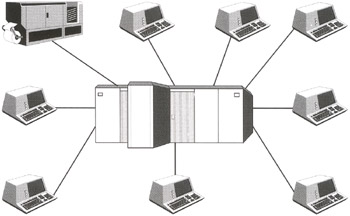
Yet it is not really the terminals that we should look to initially. Certainly, the low cost terminal, and more especially the Personal Computer (PC), have each played their part in opening the world of computing to the masses. But it is the processor that we shall look to first. Mainframe computing comes at a price, and one that could not be met by most smaller companies. These monoliths would cost hundreds of thousands of dollars, or even millions, yet the processors were based on a