LAN Technologies Explained

From the familiar to the esoteric, this book delivers on its promise of covering just about anything you ll ever want to know about networks.
 TABLE OF CONTENTS
 So far, our discussions of Ethernet/802.3 technologies have centered around the tried and trusted 10Mbps technologies of the past. Not content with such minuscule bandwidth availability though, designers sought to increase speeds to the dizzy heights of 100Mbps. Hence, Ethernet was now firmly back in contention against those deterministic, and indeed higher speed, LANs such as IEEE 802.5/Token Ring and even FDDI. Ethernet, however, due to its larger market share and lower-priced components easily competes on price against FDDI and, as we will see, provides an easy migration path for existing "low-speed" Ethernet installations.
IEEE 802.3u introduced this 100Mbps system, known collectively as 100Base-X, that encompasses 100Base-Tx, 100Base-Fx, and 100Base-T4. [1] Specifically, 802.3u defines a family of 100Mbps physical layers that can be used with the already scaleable MAC layer, and also introduces certain changes in the way that our model maps to the ISO architecture in support of these new physical layers. Figure 9-1 shows these changes that, although far from major, make the overall architecture more logical, and therefore makes it easier to accommodate newer technologies as they become available.
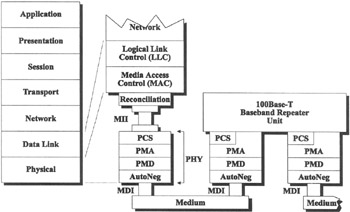
In this new architecture, several new sublayers are introduced, such as the Reconciliation Sublayer (RS) and the Media Independent Interface (MII). Although these are discussed in some detail in the next sections, it is worthwhile providing a basic idea of their functionality here since these new sublayers provide the major change to the architecture itself. The Media Independent Interface is designed to...