LAN Technologies Explained

From the familiar to the esoteric, this book delivers on its promise of covering just about anything you ll ever want to know about networks.
 TABLE OF CONTENTS
 As we have seen in previous chapters, regardless of the technology in use, LAN segments of infinite length cannot be constructed. Medium segment length is, as we have learned, constrained by several factors, not least of which are the electrical and/or optical characteristics, and the overall velocity of propagation. Indeed, as a result of these limitations, the number of MAUs that can be attached [1] on Bus topologies is also restricted in a similar fashion. So, where we wish to extend the distance of the LAN by adding segments, or indeed just increase the number of stations attached, we need to join segments together with special devices called Repeaters.
Repeaters are not limited to use within Bus topologies though. The Hub used with point-to-point topologies such as 10BaseT and 10BaseFx can also be a repeater, [2] it is just that in this case, the device has many ports.
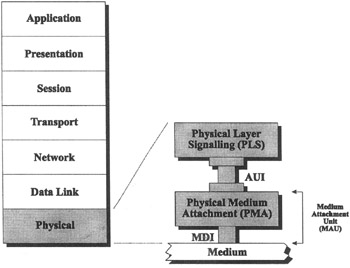
So what makes a repeater so special? In real terms repeaters are actually extremely simple devices, and being physical layer devices as they are, are totally transparent to stations. Repeaters are only concerned with electrical, mechanical, and timing functions, and can therefore be summarized as devices that simply Re-generate and Re-time medium signals. Figure 8-1 shows schematically the relationship between repeaters and the OSI Model.
[1]See chapter 3 for a discussion of limitations in this regard.
[2]It is important that Repeated Hubs are not confused with...