LAN Technologies Explained

From the familiar to the esoteric, this book delivers on its promise of covering just about anything you ll ever want to know about networks.
 TABLE OF CONTENTS
 The Medium Attachment Unit (MAU), or Transceiver as it is more commonly known, allows the connection of the DTE to the physical network medium. MAUs are designed to be simple and inexpensive, yet should also provide a flexible means of station attachment. As an example of the inherent flexibility, consider that several media standards exist. These standards include coaxial cable, twisted-pair, and fiber, yet the basic functionality of the transceiver remains constant. Indeed, only the Medium Dependent Interface (MDI), and with it the driver circuitry, needs to change to accommodate each of these different media types.
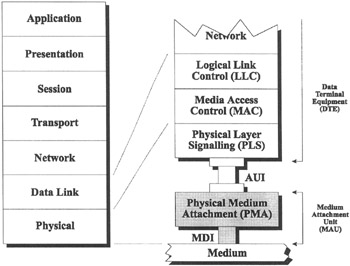
In general then, we can define the major MAU functions as follows:
Enables the PLS layer to access the medium.
Provides a mechanism by which the DTE can transmit data onto the medium. In this, the MAU must be capable of driving signals over the entire distance of the physical medium that, in the case of fiber optics, could be up to 2km.
Allows the reception and recovery of a signal from any other station.
Detects the presence of collisions on the medium and signals the PLS layer accordingly. In this way, the DTE is able to take appropriate action and retransmit data if required.
Ensures that an attached station releases the medium in a timely fashion, and therefore prohibits the station from a situation known simply as Jabbering.
Allows the DTE to test both the medium and the MAU itself.