LAN Technologies Explained

From the familiar to the esoteric, this book delivers on its promise of covering just about anything you ll ever want to know about networks.
 TABLE OF CONTENTS
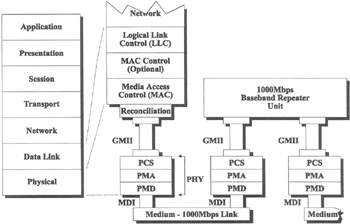
 Gigabit Ethernet is the newest and fastest Ethernet technology to date. In real terms IEEE 802.3z (the correct specification for the colloquially termed Gigabit Ethernet) brings further changes to the original 802.3/8802-3 standards. In fact 802.3z defines an extended MAC, and as with our 100Mbps technologies, a set of physical layers. Architecturally our model changes once more (see figure 10-1), and although these changes may seem cosmetic, they are actually more than just changes to terminology.
Before looking at these changes and indeed the operation of the 1000Mbps system, it is worthwhile reviewing the architectures of all Ethernet/802.3 flavors. Figure 10-2 shows this evolution, and from this it is clear that backwards compatibility has been maintained wherever possible.
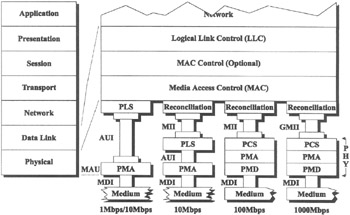
Working from the left, we see the traditional PLS/AUI/PMA architecture applicable to both 1Mbps and 10Mbps systems. The Reconciliation layer, introduced with 100Mbps is however applicable to both 10Mbps and 100Mbps systems as shown. At this time, the concept of the Medium Independent Interface (MII) was also introduced, and as we shall see later, is modified for operation at 1000Mbps. Finally, the optional MAC Control sublayer is introduced with our 1000Mbps system, and as we have already said, modifications to the MAC itself are also introduced.
So what changes does this new standard bring? Put simply, the newly extended MAC is connected to Physical Layer (PHY) entities through the new Gigabit Media Independent Interface (GMII). The PHY...