LAN Technologies Explained

From the familiar to the esoteric, this book delivers on its promise of covering just about anything you ll ever want to know about networks.
 TABLE OF CONTENTS
 The Physical Layer Signaling (PLS) and the Attachment Unit Interface (AUI) together define the electrical and mechanical characteristics of the interface between the Data Terminal Equipment (DTE) [1] and the Medium Attachment Unit (MAU). [2] As you will recall from previous chapters however, depending upon the characteristics and/or architecture of the attached device, the MAU (and therefore the AUI) may indeed be part of the physical Network Interface Card in use (within the DTE). Thus, when discussing these elements of the Ethernet/IEEE 802.3 standard, we must be aware that the AUI may actually be internal to the device.
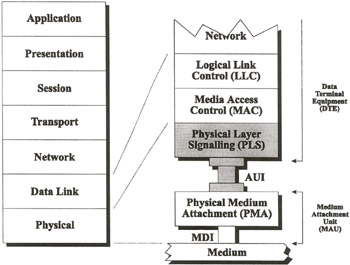
The original design purpose of the interface was to provide an interconnection method that was both simple and inexpensive. In turn, this permitted the development of simple and inexpensive MAUs. With the price of networking devices falling, brought about both by user demand and mass production, it is fair to say that this basic design criteria has been met. In general then, the interface has the following characteristics:
It is capable of supporting one or more data rates.
Many network interfaces today are designed to automatically detect, and run at, either 10Mbps or 100Mbps. When the standard was first written however, these devices typically ran at 10Mbps only.
Where the AUI is external, the device must be capable of driving a signal up to 50m between the Network Interface of the DTE and the MAU.
Where the AUI is internal, it...