LAN Technologies Explained

From the familiar to the esoteric, this book delivers on its promise of covering just about anything you ll ever want to know about networks.
 TABLE OF CONTENTS
 In this chapter we shall discuss the services provided by the MAC layer, the actual MAC frame format, and exactly how the medium is accessed. When we talk of the services provided by the MAC layer however, we must define to whom these services apply. When talking of an IEEE 802.3 environment, then these services are provided to the Logical Link Control (LLC) layer. In Ethernet however, the LLC is not used and therefore our services are provided directly to the Network layer instead. In any event, the MAC layer provides a set of clearly defined services to the layer above, and it is these that we shall examine here.
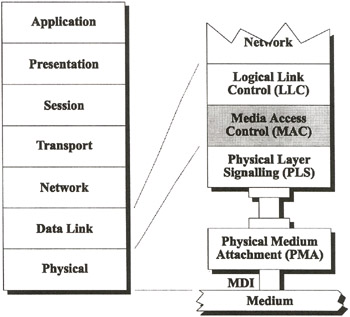
In the most general of terms, the standards define the MAC layer as being a medium-independent facility built upon the medium-dependent Physical Layer. More specifically however, we can break this functionality down and say that this layer provides two major functions namely data encapsulation, and media access management. While these may appear simple when compared to technologies such as Token Ring and FDDI, they are relatively complex in their own right. This complexity is born of the fact that Ethernet/802.3 networks place greater constraints upon the actual allowable payload size, and access to the medium is not controlled by any ordering mechanism.
Data Encapsulation/Decapsulation
Our MAC layer is responsible for the encapsulation of data at transmission, and subsequent decapsulation by receiving stations. Furthermore, we can define...