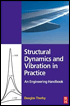
Structural Dynamics and Vibration in Practice: An Engineering Handbook
Chapter 1: Basic Concepts

This introductory chapter discusses some of the basic concepts in the fascinating subject of structural dynamics.

1.1 Statics, Dynamics and Structural Dynamics

Statics deals with the effect of forces on bodies at rest. Dynamics deals with the motion of nominally rigid bodies. The two aspects of dynamics are kinematics and kinetics. Kinematics is concerned only with the motion of bodies with geometric constraints, irrespective of the forces acting. So, for example, a body connected by a link so that it can only rotate about a fixed point is constrained by its kinematics to move in a circular path, irrespective of any forces that may be acting. On the other hand, in kinetics, the path of a particle may vary as a result of the applied forces. The term structural dynamics implies that, in addition to having motion, the bodies are non-rigid, i.e. 'elastic'. 'Structural dynamics' is slightly wider in meaning than 'vibration', which implies only oscillatory behavior.

1.2 Coordinates, Displacement, Velocity and Acceleration

The word coordinate acquires a slightly different, additional meaning in structural dynamics. We are used to using coordinates, x, y and z, say, when describing the location of a point in a structure. These are Cartesian coordinates (named after Ren Descartes), sometimes also known as 'rectangular' coordinates. However, the same word 'coordinate' can be used to mean the movement of a point on a structure from some standard configuration. As an example, the positions of...

UNLIMITED FREE
ACCESS
TO THE WORLD'S BEST IDEAS

SUBMIT
Already a GlobalSpec user? Log in.

This is embarrasing...

An error occurred while processing the form. Please try again in a few minutes.

Customize Your GlobalSpec Experience

Category: Mechanical Engineering Services
Finish!
Privacy Policy

This is embarrasing...

An error occurred while processing the form. Please try again in a few minutes.