Structural Dynamics and Vibration in Practice: An Engineering Handbook
When a structure is excited by a broad-band Gaussian random input, and the response is also broad band, there is no easy way, in general, to estimate its fatigue life. However, if the response can be considered to be confined to a narrow frequency band, as in a large proportion of practical cases, an approximate prediction of the fatigue life becomes feasible. It should be recognized that such estimates are far from reliable, and testing remains essential in critical cases. The method outlined here relies upon the fact that a narrow band Gaussian random waveform has a well-defined peak distribution, the Rayleigh distribution, enabling the Palmgren-Miner hypothesis to be used, provided an S-N diagram for the material is available. These concepts are first introduced, and then combined to develop a practical method.
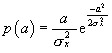
If the response of a linear system to a random input is confined to a narrow band of frequencies, it has the appearance shown in Fig. 10.22. It is roughly sinusoidal, but with a randomly varying envelope. Although the amplitude distribution remains Gaussian, the distribution of the peaks can be shown to have a Rayleigh probability density given by:
| (10.90) | |
where: a is a peak value of the response, which can be a displacement, stress, etc.; p(a) is the probability density of the peaks, i.e. the probability of a peak lying between a and a + da;