Structural Dynamics and Vibration in Practice: An Engineering Handbook
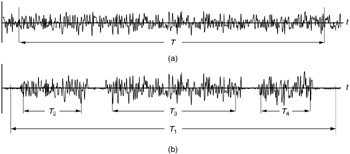
Mathematically, the conventional analysis of random waveforms requires them to be stationary and ergodic. Stationarity applies to a single waveform, and implies that its average properties are constant with time. Ergodicity applies to an ensemble of a large number of nominally similar waveforms, recorded in similar conditions. If these all have similar average properties, it suggests that it is reasonable to assume that the one or two records that we are able to analyse are typical of the process as a whole. Since there are no hard and fast criteria, in practice we must rely on common sense to ensure that the records we analyse are at least reasonably stationary. The concept of stationarity is illustrated by Fig. 10.1, which shows sketches of two random waveforms. That shown at (a) is obviously fairly stationary, and we would be justified in choosing the period T for analysis. On the other hand, the record shown at (b) is clearly non-stationary, and conventional analysis over the period T 1 would, at best, only give average properties over that period, and not of the periods T 2, T 3 and T 4, which are obviously more severe, and therefore more important in practice.
Techniques such as wavelet analysis [10.1] have been developed, specifically for dealing with non-stationary data, but these are beyond the scope of this book. However, even using conventional methods, there...