Structural Dynamics and Vibration in Practice: An Engineering Handbook
The operations described next are normally carried out in one of two ways:
A general-purpose computer, with appropriate software, may be used. In this case anti-aliasing filtering of the analog data, as described in Chapter 9, must first be carried out, followed by analog to digital (A to D) conversion. These preliminary steps may well be performed remotely, for example in an air or space vehicle, and the digital data stored on tape or disk, for later analysis, or transmitted to a ground station by a radio link.
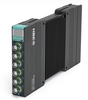
Alternatively, all these functions can be combined in a single box known as a spectrum analyzer. These usually accept two, four or more simultaneous channels of analog data directly, and are very easy to use, as the integrated design enables appropriate anti-aliasing filters and A to D conversion to be switched in automatically.
In either case, the digital operations required to transform random time histories into useful functions, such as power spectra, enabling practical random vibration problems to be understood and solved, will usually be as described in the following sections. The DFT, as introduced in Chapter 9, and implemented by the FFT algorithm, is used almost exclusively in this work.
We should now review some essential results from Chapter 9 before proceeding further.
The Fourier series representing a periodic waveform, x( t), is defined, by Eq. (9.3), as:
| (9.3) | |
where a 0 is the mean...