Structural Dynamics and Vibration in Practice: An Engineering Handbook
In this chapter, we introduce some of the basic tools that will be required for the practical analysis of vibration data, preparatory to the discussion of random vibration in Chapter 10. The classical Fourier series is first introduced, looking briefly at how the Fourier integral and the Fourier transform are related to it. We then consider the discrete Fourier transform, or DFT, the 'computer-friendly' version of the Fourier series, and the basis of most modern digital vibration analysis. The use of digital signal processing brings with it the possibility of serious errors due to the phenomenon of aliasing, which is introduced next. Finally, the response of systems to periodic excitation is discussed.
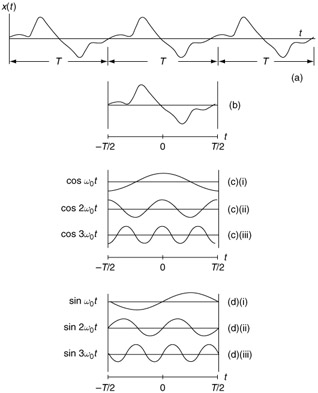
Figure 9.1 at (a) represents a periodic waveform, x( t), which repeats exactly every T seconds. It was postulated by J. Fourier that this can be represented, subject to some minor exceptions in the case of discontinuities, by a series of the following kind, extending, theoretically, to infinity:
| (9.1) | |
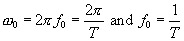
where
| (9.2) | |
The frequency ? 0, in rad/s (or f 0 in Hz), is the fundamental frequency of the harmonic series represented by Eq. (9.1), and all the other frequencies are integer multiples of this frequency.
Equation (9.1) can be expressed in the more compact form:
| (9.3) | |
The constant a 0 is easily found, since it is the average...