Structural Dynamics and Vibration in Practice: An Engineering Handbook

10.2: Amplitude Probability Distribution and Density Functions

10.2 Amplitude Probability Distribution and Density Functions

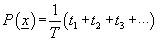
Figure 10.2(a) shows a random waveform, x( t), from which a sample of length, T, has been selected for analysis. A small part of the waveform is shown enlarged in Fig. 10.2(b). The probability, P( x), that the waveform has a value less than x, a particular value of x, is given by counting up the total time that it spends below x, which will be the sum of periods such as t 1, t 2, t 3 , expressed as a fraction of the total time T, thus,

(10.8)

Figure 10.2: Derivation of amplitude probability and density functions.

If this is repeated with x set to a number of different values of x, a plot of P( x) versus x can be obtained. P( x) is known as the cumulative amplitude probability distribution. Although many different shapes are possible, all must have the following features:

  1. The value of P( x) when x = - ?, that is, P(- ?), must always be zero, since there is no chance that the waveform lies below - ?. It may, of course, be zero up to a value of x greater (less negative) than - ?.

  2. The value of P( x) can never decrease as x becomes more positive.

  3. The value of P

UNLIMITED FREE
ACCESS
TO THE WORLD'S BEST IDEAS

SUBMIT
Already a GlobalSpec user? Log in.

This is embarrasing...

An error occurred while processing the form. Please try again in a few minutes.

Customize Your GlobalSpec Experience

Category: X-ray Sources
Finish!
Privacy Policy

This is embarrasing...

An error occurred while processing the form. Please try again in a few minutes.