Flexibility influence coefficients for simple beams in bending or torsion can be calculated easily using the following methods. The bending case is considered first.
The potential energy, U B, due to bending, in a beam, is
| (B1) | 
|
where the integration is carried out over the whole length of the beam, and
M is the bending moment as a function of x;
x is the distance along the beam;
E is the Young's modulus and
I is the second moment of area of the cross-section.
Since
| (B2) | 
|
where  is the curvature. Eq. (B1) can also be written in the form:
| (B3) | 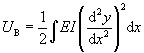
|
If a load P is applied to the beam, Castigliano's first theorem states that the resulting displacement, at the same point, and in the same direction, is y P, where:
| (B4) | 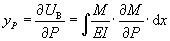
|
or
| (B5) | 
|
where m =  is the moment per unit load, and can be interpreted as the bending moment function due to a dummy unit load at the point where the displacement, y, is required.
Equation (B5) can be used to calculate flexibility influence coefficients for simple beams in bending. Taking the cantilevered beam shown in Fig. B1 as an example, suppose we require the flexibility influence coefficient ? 21, which is defined as the displacement y at x 2 due to a unit load at x l. Figure B1 shows M, the bending moment function due to the actual unit load...
Copyright Elsevier Ltd 2008 under license agreement with Books24x7

 TABLE OF CONTENTS