Structural Dynamics and Vibration in Practice: An Engineering Handbook
Spectra representing sound pressure histories are usually presented in a special way, expressing the power in decibels (dB) in octave-based frequency bands, rather than as PSD plots. This method of presentation is largely due to two factors: (1) it was originally designed for studies involving human hearing, which has a naturally logarithmic response, and (2) it was based on the use of analog filter methods, which are more conveniently set up using bands consisting of a fixed fraction of an octave, rather than of a fixed number of hertz.
This method of presentation, although designed for audio work, using analog methods, has survived into the digital age, and is still widely used in purely structural applications. Structural dynamics work may therefore involve converting from the 'acoustics' method to the 'spectral density' method, and vice versa. The 'acoustic' method of presentation is now discussed, with an example showing a typical conversion to the PSD method.
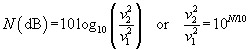
The decibel is one-tenth of the original unit, the bel (B). This was found inconvenient for practical use, and was divided into 10 decibels. The decibel scale alone, without reference to a standard level, is simply a way of expressing the factor by which an oscillatory quantity, such as voltage, force, pressure, etc., changes. It is defined in terms of power (mean square) values. So, for example, if an RMS voltage, v 1, changes to v 2, the change expressed in dB is N, say, where:
| (C1) | |
Equation (C1)...