Surfaces and their Measurements
This book is primarily intended to help designers and inspectors to understand the fundamentals of surface metrology and, where appropriate, point to relevant procedures for specification.
 TABLE OF CONTENTS
 The object of this book is to clarify the situation regarding surface metrology manufacture and performance. It is not to provide intricate detail on procedures or instruments but more to explore the reasons behind specifications and standards. When and where to apply 'one number' values will be indicated. Necessary discrimination between parameters will be described, wherever appropriate, and redundant discrimination highlighted.
In particular, the whole philosophy of the book will be to separate out the uses of surface measurement. Manufacturing aspects will be considered apart from functional effects. The reasons for the dichotomy of use and the problems caused by failure to recognize the difference in use will be discussed.
Surface parameters have been used as attributes and not as variables; the trouble is that when to use the one or the other has never been clear and is still not clear.
The expression 'surface metrology' usually conjures up pictures of rough surfaces probably having regular triangular or sine wave shapes. These simple pictures correspond to the mark produced by the tool in removing material. In addition, longer waves are produced by errors in the path of the tool, which in effect cause departures from its intended shape. These could be roundness errors, straightness errors or even errors of form. Figure 1.1 shows a general shape, highly magnified.
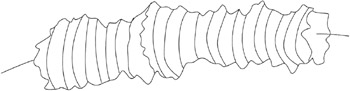
This is very far from an ideal cylinder.
Figure 1.2 shows exactly the same sort of deviations on a...