Surfaces and their Measurements
This book is primarily intended to help designers and inspectors to understand the fundamentals of surface metrology and, where appropriate, point to relevant procedures for specification.
 TABLE OF CONTENTS
 From what has been said, it is clear that the autocorrelation and power spectrum can be used in surface analysis. One fundamental type of spectrum is given below for, say, a ground surface.
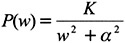
Fractal surfaces have a similar spectrum
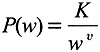
v, the index for fractal surfaces, can take values between 0 and 2 allowing non-integer values. From this index, one of the two fractal parameters can be obtained. Thus + v = 5-2D; the other parameter called the topothesy ? can be obtained from the structure function [3.11].
There is a big debate at present about the relevance of fractals in surface metrology. Why bother? The essential property of a fractal surface is that the parameters D and A work out to be the same whatever the scale - a bit like 'fleas on fleas' as seen in Figure 3.52. All conventional parameters like curvature, slopes etc. are very scale-sensitive. Using conventional geometry, there is no such thing as a number or numbers representing the surface.
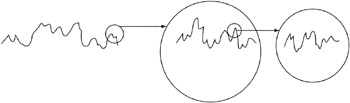
So, the idea is that with fractal geometry under certain conditions, a unique number can be assigned to the surface. At first sight, this appears to be a breakthrough in surface characterization but there is a snag. This is that functional uses of surfaces are very scale-dependent as will be seen later. Consequently, surface parameters hoping to predict performance should be equally scale-dependent. In other words, fractal geometry is precisely what...