Surfaces and their Measurements
This book is primarily intended to help designers and inspectors to understand the fundamentals of surface metrology and, where appropriate, point to relevant procedures for specification.
 TABLE OF CONTENTS
 So far, deviations from ideal shapes, which are linear or substantially so, can be related to a straight generator. There are, however, many other different shapes that are equally important. In particular, the circle can be regarded as one such geometric element from which more complex engineering forms can be derived. About 70% of all engineering components have an axis of rotational symmetry in them somewhere. The importance of this was first realised by R. E. Reason of Taylor Hobson in 1951 [11.1], who set out almost single-handed to build instruments to measure roundness. Out-of-roundness or, more simply, roundness will now be considered as the next logical step in building up a more total geometry of a surface.
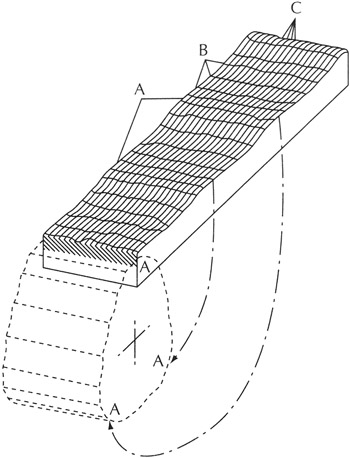
How the roundness error can be visualized with respect to surface texture errors is shown in Figure 11.1. Also shown in the figure are roughness marks C and waviness marks A and B.
Roundness or, strictly, out-of-roundness is more important than is usually thought. It is not generally realized that the energy needed to turn or grind comes from rotation; either from the workpiece or the tool. This rotation is absolutely critical to the process and the efficiency of the energy transfer is largely determined by the axis of rotation.
Control of the rotational axis is achieved by roundness measurement (Figure 11.2 (a)).
Very many of the common machining processes are rotational e.g. grinding, turning and...