Surfaces and their Measurements
This book is primarily intended to help designers and inspectors to understand the fundamentals of surface metrology and, where appropriate, point to relevant procedures for specification.
 TABLE OF CONTENTS
 Before discussing specific instruments, it is necessary to consider some of the problems associated with optical methods in the same way that elastic and plastic deformations were examined for the stylus instrument.
Also, it should be realized that the pedigree of optical methods is at least as good as that of the stylus instrument [8.1 8.4]. Just looking at a workpiece from different angles shows how versatile light scatter is.
Figure 8.1 shows a graph on which optical techniques are represented on the abscissa. The ordinate axis has two variables, one being speed and the other fidelity. It is true to say that it is not economically feasible to get both. The closer the method is to the stylus method, the more it is likely to be slower but have more fidelity.
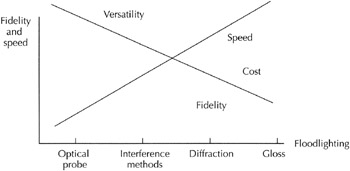
Each one of these methods will be discussed briefly. Perhaps the best place to start is with the simple gloss meter. This will be examined after some optical properties have been discussed.
Figure 8.2 illustrates a flat surface upon which two films have been deposited. They are the same thickness but different refractive indices n 1 and n 2. A stylus instrument measuring this surface would give a straight line because it is responding to the geometry. If an optical probe is used, a clear step occurs where the films change. This is not wrong; it is showing what optics can do under these circumstances.