Surfaces and their Measurements
This book is primarily intended to help designers and inspectors to understand the fundamentals of surface metrology and, where appropriate, point to relevant procedures for specification.
 TABLE OF CONTENTS
 Some parameters can be estimated without using an instrument. In fact, before instruments were generally available, the surface was examined quite successfully yet subjectively with the eye and the fingernail. Never denigrate this approach. Far too many people, including designers, do not look at the surface enough.
Figure 6.1 (a) shows the light scatter from a surface when a ray of light is thrown onto it. The light is scattered over a range of angles. However, if the incident ray and the eye are positioned at a glancing angle off the surface (Figure 6.1 (b)) the surface can behave as if it is a mirror. This is called Lambert's Law. Why it does this is indicated in Figure 6.1(c).
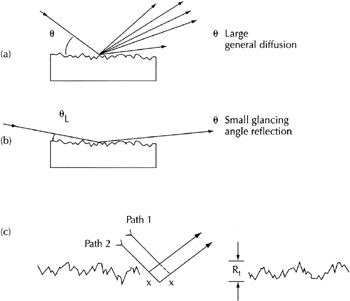
From Figure 6.1 (c), the path difference is 2x between rays off peaks (path 1) and between rays off valleys (path 2). From Figure 6.1 (c), R t ~  .
.
The surface is tilted until it acts like a mirror. This occurs at a small glancing angle ? L. The difference in path length of rays hitting peaks (as path 2) in the figure and rays hitting valleys (as path 1) is approximately ?, where ? is the wavelength of light (~0.6 ?m).
For example, if R t is 1 ?m, the Lambert angle ? L is sin -1(  )~...
)~...