Surfaces and their Measurements

This book is primarily intended to help designers and inspectors to understand the fundamentals of surface metrology and, where appropriate, point to relevant procedures for specification.
 TABLE OF CONTENTS
 Figure 3.33 attempts to put in perspective the role of areal measurement with respect to the profile. Note that the term (3D) roughness is wrong. The correct term is areal (2D) as compared with profile (1D). However, the 3D is put in brackets for clarity. A profile has one demand; axis 'x' and one dependent measurement from it, 'z'. Areal measurement has two demand axes 'x' and 'y' and one dependent measurement from it, 'z'. Areal information can be useful in monitoring the condition of the machine tool. For example, errors in the path of the tool due to chatter can be assessed. Process information can be investigated via the profile. Built-up edge in turning or dressing requirement as in grinding can be extracted from profile information using autocorrelation or the power spectrum.
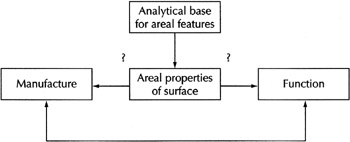
Similarly in terms of the 'function', the areal information plays a very significant role whenever fluid flow is involved parallel to the surface or surfaces.
Areal information is also important in contact situations because the longest wavelength in either lateral direction determines the positions of initial contact. Usually, this initial point of contact elastically deforms under load. The extent of this affects the actual contact. It is in this regime where detailed local information, which can be obtained from the profile, determines performance. In the case of contact energy flow normal to the surface such as electrical and thermal energy, it is...