Surfaces and their Measurements

This book is primarily intended to help designers and inspectors to understand the fundamentals of surface metrology and, where appropriate, point to relevant procedures for specification.
 TABLE OF CONTENTS
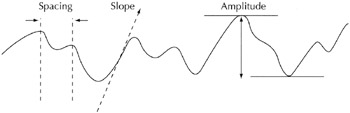
 These are amplitude, spacing and hybrid parameters as shown in Figure 3.1. Amplitude and spacing parameters are self-evident. Hybrid parameters are those obtained, usually indirectly, via the spacing and amplitude parameters e.g. slope.
The question of which parameter to use for surface roughness is a difficult one because of the lack of real information. The magnitude of the problem is large. For example, take a ground surface of 25mm diameter and 100mm long - a quite typical workpiece. The correlation length (the size of a typical hit by a grain) is about 10 ?m and the aspect ratio of the grinding mark is perhaps 50:1. So, the number of independent hits on the part is given by N 1 = 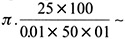 1M bits. Yet from the point of view of performance, all that is needed is to know whether the part is good or not! One bit of information. Yet there are millions to pick from as the calculation shows.
The number N i is the number of potential locations on the specimen where nominally independent height values can be located: it does not relate directly to good or bad bits of information. There is a difference. The starting point for surface failure could well be very small but, once initiated, develops as an avalanche e.g. in oil film breakdown. The starting point would have to be exceptional; e.g. an extra high peak or an...