Surfaces and their Measurements
This book is primarily intended to help designers and inspectors to understand the fundamentals of surface metrology and, where appropriate, point to relevant procedures for specification.
 TABLE OF CONTENTS
 The previous chapter considered optical ways of examining the surface. These are limited by the wavelength of light. As the requirement grows for detail much greater than the wavelength of light can provide e.g. molecularly smooth surfaces, very thin films and their associated step height, it becomes difficult to justify the continued use of optics. One rule of metrology is that the unit of measurement should be close to the size of the feature of interest. In a later section, some methods of using the crystal lattice as a unit will be described but there is another alternative, which is to use electrons instead of light. The equivalent wavelength of a moving electron is ? e = 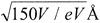 or
or  , where h is Planck's constant and p is the electron momentum. V is the acceleration voltage for the electrons. Putting the relevant values in the formula gives theoretical wavelength for the electron at about 0.1, which is about 10 -5 times the wavelength of light. This practically, is about 10 4 times smaller.
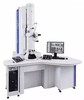
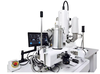
There are a number of microscopes that make use of electrons rather than light in order to improve the lateral resolution. One uses the electrons in transmission (TEM) and another in electron scanning mode (SEM), which is similar to the flying spot microscope but uses electrons. Because the SEM uses a beam of electrons that has very little spread, the SEM has a very good depth of field because...