Surfaces and their Measurements
This book is primarily intended to help designers and inspectors to understand the fundamentals of surface metrology and, where appropriate, point to relevant procedures for specification.
 TABLE OF CONTENTS
 The system has been featured in Section 6.3.1, the central component being the stylus. This was originally the fingernail until Schmaltz [7.1] pushed the idea forward to a mechanical probe [7.2]. The different types are shown in Figure 7.1.
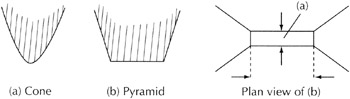
In the UK, there was first a diamond stylus of 90 pyramid shape. This had two dimensions at the tip; one of 2 ?m and the other of about 7 ?m. The 2 ?m edge traversed across the lay. The 7 ?m dimension was intended to give the stylus tip some mechanical strength . This worked well on surfaces with an appreciable lay but not at all on isotropic surfaces. The 7 ?m dimension dictates the overall resolution limit.
In the US a diamond cone was used, which had an angle of 60 . The result was that the two countries developed instruments that had different starting points, which caused some trouble with cross-calibration exercises.
It has been pointed out that the two diamond shapes are not crucial because, in practice, the cone gets a flat on it with use and the pyramid gets rounded corners with use. Although this is true for the tip shape, there is still a different angle that could make a difference on fine surfaces.
Figure 7.2 shows that the stylus slope has to be considered. The tip can be infinitely sharp but still will not penetrate completely into the groove or valley. The slope...