Logic-Timing Simulation and the Degradation Delay Model

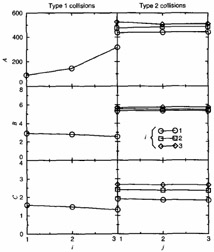
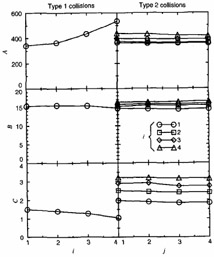
For Type 1 collisions there are no changes with respect to the exhaustive model and we must define a value of each degradation parameter for each input. Therefore, the n values of a parameter
corresponding to each input are represented in a vector:
| (5.20) | |
For Type 2 collisions, it is only necessary now to specify one value for each input ( ? Si). This value is applied to all Type 2 collisions whose second input transition occurs in the i th input, independently of the input in which the previous transition occurred. For each parameter, the n corresponding values are grouped in a vector:
| (5.21) | |
When obtaining degradation parameters ? and T 0 to calculate the delay, we can still use Eqs. (5.11) and (5.12), but now ? n will be a vector in all the cases.
To fully model a gate with respect to the degradation effect, we need 2 n values for each degradation parameter at gate-level: A, B, and C. This supposes an important simplification of the total number of parameters necessary to specify for a gate, going from 3 n( n + 1) in the exhaustive model to 6 n in the simplified model. For example, in a four input gate it means going from 60 to 24 parameters.