1.1 An Introduction to the Laplace Transform
Much of this chapter is devoted to describing and deriving some of the properties of the one-sided Laplace transform. The Laplace transform is the engineer's most important tool for analyzing the stability of linear, time-invariant, continuous-time systems. The Laplace transform is defined as:
We often write F( s) for the Laplace transform of f( t). It is customary to use lower-case letters for functions of time, t, and to use the same letter but in its upper-case form for the Laplace transform of the function; throughout this book, we follow this practice.
We assume that the functions f( t) are of exponential type that they satisfy an inequality of the form  . If the real part of s,
  , satisfies
  < ? ?, then the integral that defines the Laplace transform converges. The Laplace transform usefulness comes largely from the fact that it allows us to convert differential and integro-differential equations into algebraic equations.
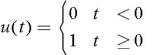
We now calculate the Laplace transform of some functions. We start with the unit step function (also known as the Heaviside [1] function):
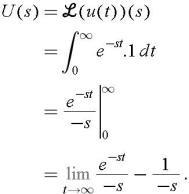
From the definition of the Laplace transform, we find that:
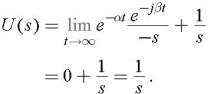
Denote the real part of s by ? and its imaginary part by ?. Continuing our calculation, we find that:
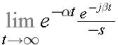
This holds as long as ? > 0. In this case the first term in the limit:
is approaching zero while the second term though...


 TABLE OF CONTENTS