Mathematical Introduction To Control Theory

We have developed many tools for the analysis of linear feedback systems. It is time to work on the problem of how best to design such systems. Often, we are given a plant to control for example a motor and we are given tools with which the output of the plant is to measured say a tachometer (a device for measuring a motor's speed). We can then add other parts to the system in order to meet the requirements imposed on the system. One requirement is, of course, that the system be stable. Another requirement might be that the system be over-damped that there be no overshoot, that the system's settling time be 1s, or that the system's phase margin be 60 . In this chapter we examine a number of the standard techniques for compensating a system for adding elements to the system to improve the system's performance. This part of control theory is something of an art, and as is typical of engineering problems there is often more than one way to design a reasonable system.
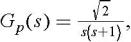
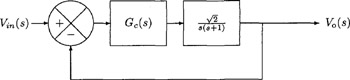
Consider the system of Figure 7.1. The transfer function of our plant is
H( s) = 1, and we are to design G c( s). This is a reasonable model for a DC motor with position feedback, for example. Suppose that we are asked to design a compensator, G c( s