Mathematical Introduction To Control Theory

Because most of the systems in which we are interested have both digital and analog parts, we need a circuit element which takes continuous-time signals and "converts" them to discrete-time signals. The sample-and-hold circuit fills this need. An ideal sample-and-hold element that samples at the rate T samples per second has as its input a signal r( t) and as its output c( t) a signal that satisfies:
(See Figure 10.1 for an example of a sine wave that has been passed through a sample-and-hold circuit.) A signal that has been processed by a sample-and-hold circuit only changes values at discrete times.
Taking the Laplace transform of both sides of (10.1), we find that:
Inspecting C( s) carefully, we find that it can be written:
Defining the "star-transform" of the sequence { r(0), r( T), r(2 T), } by:
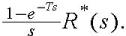
we find that the Laplace transform of the output of the sample-and-hold circuit is:
In the next sections we will see that R*( S) corresponds to samples of r( t) made by an "ideal sampler" and that
is the transfer function of a "zero-order hold."