Mathematical Introduction To Control Theory

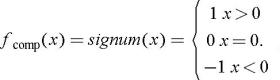
A circuit is linear if it obeys the principal of superposition if when the output corresponding to v in1 is v out1 and the output corresponding to v in2 is v out2 then the output corresponding to av in1 + bv in2 is av out1 + bv out2. Systems of the type that we have discussed until now those that have transfer functions obey the principal of superposition (under the standard condition that the systems' initial conditions are all zero). Many practical circuits are not composed solely of linear elements; circuits often contain one or more elements that behave in a nonlinear fashion. A typical nonlinear circuit element, n, is a comparator. If x is the input to a comparator, then the output of the comparator, f comp( x), is:
Let us check that the comparator does not obey the principle of superposition. If the input to the comparator is x = a > 0, then its output is f comp( x) = 1. For the comparator to obey the principle of superposition, the output when x = a + a = 2 a would have to be 1 + 1 = 2. In fact, the output is 1; the comparator is not a linear element.
When dealing with linear elements, our main concern has been with stability. We have checked that...