Mathematical Introduction To Control Theory

10.10: Calculating the Pulse Transfer Function

10.10 Calculating the Pulse Transfer Function

Let us consider a system like that of Figure 10.4 in which there is a sample and hold circuit followed by an analog element. How can we calculate the output of the analog element?


Figure 10.4: A Very Simple System

Consider the input to the zero-order hold. We know that the zero order hold has a train of delta functions as its input. Let us see what the output of the combination of the zero-order hold and the analog block is when the input to the zero-order hold is just ?( t).

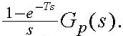
The Laplace transform of the output is just:


To find the output as a function of time one need only consider the inverse Laplace transform of this expression. Because of the time-shifting property of e ? Ts the inverse Laplace transform of this expression is actually just:


where


(The function v( t) can also be thought of as the impulse response of the block with transfer function G p( s)/( s.)

G p( s) = 1/ s An Example

Let G p( s) = 1/ s. We find that:


As e ? Ts just delays a signal by T, the inverse Laplace transform of (1 ? e ? Ts)(1/ s 2) is just:


Let us now consider what sort of data, r( t), would get us a delta function at zero at the...

UNLIMITED FREE
ACCESS
TO THE WORLD'S BEST IDEAS

SUBMIT
Already a GlobalSpec user? Log in.

This is embarrasing...

An error occurred while processing the form. Please try again in a few minutes.

Customize Your GlobalSpec Experience

Category: IC Electronic Filters
Finish!
Privacy Policy

This is embarrasing...

An error occurred while processing the form. Please try again in a few minutes.