Mathematical Introduction To Control Theory

10.11: Using MATLAB to Perform the Calculations

10.11 Using MATLAB to Perform the Calculations

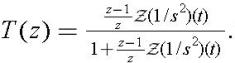
MATLAB has a set of commands that is designed to take care of the calculations that one must perform to calculate a pulse transfer function or to analyze a discrete-time or hybrid system. Let us consider the system of the previous section in which G p( s) = 1/ s and H( s) = 1. We found that with these definition the pulse transfer function of the system of Figure 10.5 is:


Let us first define the pulse transfer function ( z-1)/ z. For this purpose, one uses the command S_H = tf (a, b, Ts). ( S_H is the name of the transfer function object that MATLAB creates.) The array a defines the numerator of the transfer function. In our case it is [1-1]. (The polynomials here are represented just as they are in the continuous-time case.) The array b defines the denominator of the transfer function. In our case it is [ 1 0]. Finally, Ts is the sample time. If one uses ? 1 for the sample time, then MATLAB registers the system as discrete-time but it does not pick a sample time for the system. (If no Ts is given, then the system is taken to be continuous-time system.)

Next, we take the Laplace transform 1/ s 2 and "convert" it into a z-transform. MATLAB has a command c2d whose job it is to...

UNLIMITED FREE
ACCESS
TO THE WORLD'S BEST IDEAS

SUBMIT
Already a GlobalSpec user? Log in.

This is embarrasing...

An error occurred while processing the form. Please try again in a few minutes.

Customize Your GlobalSpec Experience

Category: Sample-and-Hold Amplifiers
Finish!
Privacy Policy

This is embarrasing...

An error occurred while processing the form. Please try again in a few minutes.