Mathematical Introduction To Control Theory

10.7: The Delta Function and its Laplace Transform

10.7 The Delta Function and its Laplace Transform

In what follows it will be useful to consider the delta function (or the Dirac delta function). The delta function is the function [2] that is zero at all points other than 0, that is infinite at zero, and whose integral over the real line is one. The delta function is denoted by ?( t).

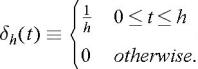
Let us consider the family of functions ? h ( t) defined by:


We can say that:


Note that as the integral of ? h is one for any h, the integral of ?( t) should be one as well.

Making use of the definition of the Laplace transform we find that:


As e ? x = 1 ? x + x 2/2! + , we know that for small values of x e ? x ? 1 ? x. We find that as long as sh is small, the Laplace transform of ? h ( t) is approximately equal to one. As ?( t) = lim h?0+ ? h( t) we find that the Laplace transform of ?( t) should be:


The Laplace transform of ?( t) should be, and is, 1.

[2]Strictly speaking the delta function is not quite a function, but we will not worry about the technical problems that surround the delta function's definition.

UNLIMITED FREE
ACCESS
TO THE WORLD'S BEST IDEAS

SUBMIT
Already a GlobalSpec user? Log in.

This is embarrasing...

An error occurred while processing the form. Please try again in a few minutes.

Customize Your GlobalSpec Experience

Category: Color Meters and Appearance Instruments
Finish!
Privacy Policy

This is embarrasing...

An error occurred while processing the form. Please try again in a few minutes.