Mathematical Introduction To Control Theory

10.9: The Zero-Order Hold

10.9 The Zero-Order Hold

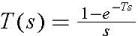
For our purposes, what is important about the discrete-time part of our system is not the precise representation of the discrete-time signal. What we need to know is the value of the signal at a particular sample. For this reason, we use either the star-transform or the z-transform to represent our signal in the discrete-time region. To convert the signal from discrete-time back to steps in continuous time, we use the zero-order hold block. This block has the transfer function:


Suppose that one inputs a delta function of strength h at time ? to this block. Then the Laplace transform of the output of the block, C( s), is just:


Thus, the output as a function of time is:


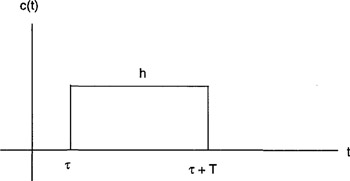
this function is zero until t = ? and after t = ? + T. Between these times it is a pulse whose height is h.

The zero-order hold takes a delta function of strength h that arrives at time ? and converts it into a pulse of height h that starts at the time at which the delta function arrived and ends T seconds later. (See Figure 10.3.)


Figure 10.3: A Pulse of Height h and Duration T Starting at t = ?

UNLIMITED FREE
ACCESS
TO THE WORLD'S BEST IDEAS

SUBMIT
Already a GlobalSpec user? Log in.

This is embarrasing...

An error occurred while processing the form. Please try again in a few minutes.

Customize Your GlobalSpec Experience

Category: Sample-and-Hold Amplifiers
Finish!
Privacy Policy

This is embarrasing...

An error occurred while processing the form. Please try again in a few minutes.