Mathematical Introduction To Control Theory

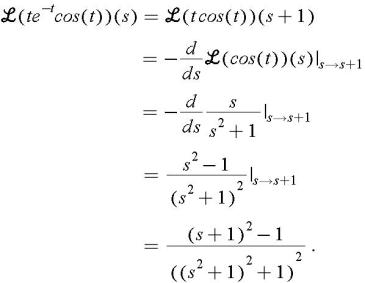
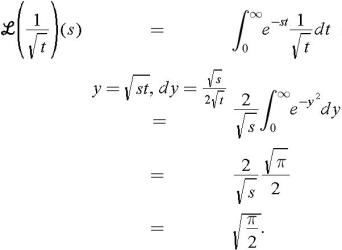
1.a. On page 5 we found that:
Using the dilation property of the Laplace transform, we find that:
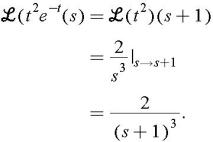
1.b. We find that:
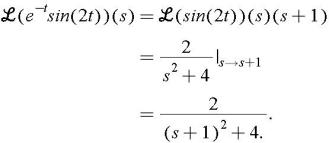
1.c. We find that:
1.d. We find that:
3. We must solve the ODE:
subject to the initial conditions y(0) = y ?(0) = 0. Taking the Laplace transform of both sides (and noting that the Laplace transform of 1 and of u( t) must be the same because the functions are identical when t > 0), making use of the initial conditions, and denoting the Laplace transform of y( t) by Y( s), we find that:
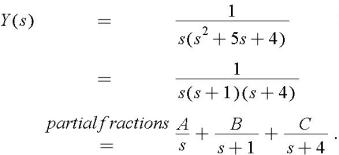
Thus, we find that:
After clearing denominators we find that:
Rewriting this, we find that:
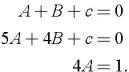
Equating coefficients, we find that:
We find that A = 1/4, B = ?1/3, and C = 1/12. Thus:
We see that:
5. We must solve the integral equation:
Taking Laplace transforms and denoting the Laplace transform of y( t) by Y( s), we find that:
Rearranging the terms, we find that:
We find that:
Clearing the denominators, we find that:
Rewriting this, we find that:
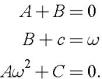
Equating coefficients we find that:
Solving these equations we find that:
We find that:
By inspection, the inverse transform of this is just:
7. Following the instructions given in the problem, we find that: