6.2. Particle Arrangement and Equations
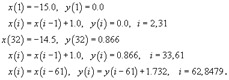
Consider first a 30 cm by 240 cm rectangle and on it construct a regular triangular grid with 8479 points, shown in Fig. 6.1, by the recursion formulas
 Figure 6.1: 8479 particles.
The side of each triangle in the grid has length 1 cm. At each grid point ( x i, y i) set a particle P i, that is an aggregate of molecules. Thus, the distance between any two immediate neighbors is unity.
Each particle is assigned a speed of 0.0001, with its sign and direction determined completely at random.
Now we wish the particles to behave somewhat like molecules in the sense that close particles will repel while more distant ones will attract. However, since particles will be relatively massive, we do not wish them to exhibit the volatile motion common to molecules. Hence, the force between two distinct particles P i and P j which are R ij cm apart will be taken to have magnitude F given by
| (6.1) | 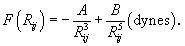
|
Thus,
| (6.2) | 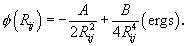
|
Our first problem is to determine A and B. Assume that F(1) = 0, so that from (6.1),
| (6.3) | 
|
In order to determine a second equation, some relevant observations must be made first.
Let us direct attention first to water vapor molecules. Note that the number N of molecules which can be arranged in the rectangle using the regular triangular grid approach is
| (6.4) | 
|
Also, note that since the...


 TABLE OF CONTENTS