Molecular and Particle Modelling of Laminar and Turbulent Flows

In each of the following examples ? t = 0.00001 and J = 20000. If a particle has crossed one of the lower three walls, its position is reflected back symmetrically, its velocity component parallel to the wall is set to zero, and its velocity component parallel to the wall is multiplied by -1. If the particle has crossed the moving wall, its position is reflected back symmetrically, its Y component of velocity is multiplied by -1, and its X component of velocity is increased by the wallspeed V.
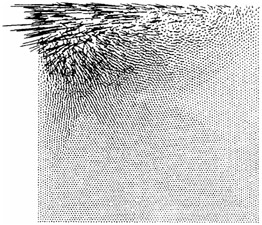
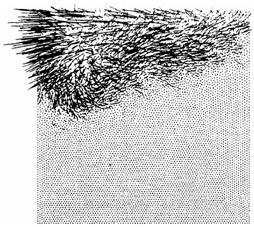
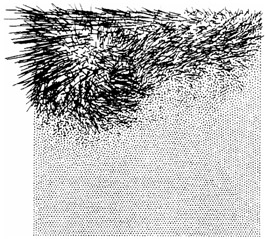
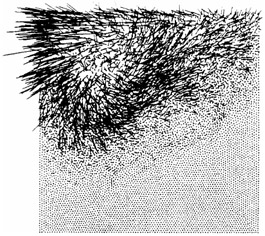
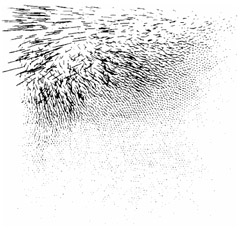
Let V = -40. Then Figs. 6.4 6.7 show the development of a primary vortex at the respective times t = 0.2, 0.6, 1.0, 1.4. Entirely similar results followed for J = 14000, 11000, 9000. Figure 6.7 compares most favorably with that in Fig. 2.6.
Let V = -100. Figures 6.8 6.10 show the rapid development of a primary vortex, larger than that in Example 1, at the respective times t = 0.2, 0.6, 1.0. In this example, the velocity vectors had to be reduced by the factor vm = 0.02 for graphical clarity. Entirely similar results followed for J = 14000, 11000, 9000.