Molecular and Particle Modelling of Laminar and Turbulent Flows

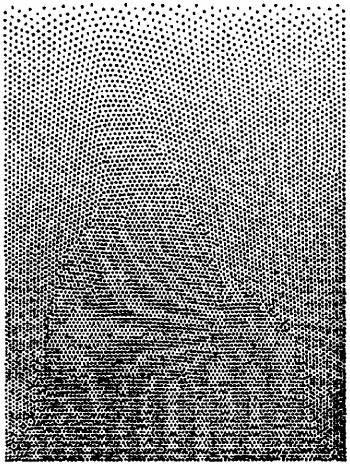
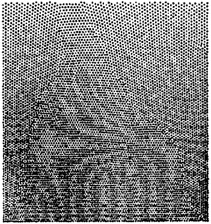
We now allow the 8479 particles in Fig. 6.1 to find their own equilibrium when interacting in accordance with (6.11). We choose ? t = 0.00005 and use the usual reflection protocol, that is, if a particle crosses a wall, it is reflected back symmetrically, its velocity component tangent to the wall is set to zero, and its velocity component perpendicular to the wall is multiplied by -1. The initial motion of the system is almost one of free fall. So for the first 40000 time steps, each velocity is damped by the factor 0.2 every 20000 time steps. For the next 40000 time steps, each velocity is damped by the factor 0.4 every 20000 time steps. For the third 40000 time steps, each velocity is damped by the factor 0.7 every 20000 steps. For the final 40000 steps the damping is removed. In this fashion, the particles are eased down into the configuration shown in Fig. 6.2. Finally, to obtain a square set of particles, all particles with y i > 30 in Fig. 6.2 are removed to yield the 7549 particle set shown in Fig. 6.3. The positions and velocities of these particles are used as the initial data for the cavity flow examples to be described next.