6.8. Particle Equations of Motion
We assume for two particles P i, P j the potential
| (6.14) | 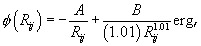
|
in which R ij is the distance in centimeters between the particles. Thus, the force  which particle P j exerts on particle P i is
| (6.15) | 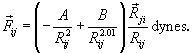
|
Our first problem is to determine A and B. Let 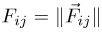 . Then in consistency with the way the particle positions were generated, let F(0.05) = 0, so that
| (6.16) | 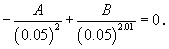
|
In order to determine a second equation, some relevant observations must be made first.
Note that the number N of molecules which can be arranged in the 0.4 cm by 17.6 cm rectangle using a regular triangular grid is
| (6.17) | 
|
Also, note that since the mass M of a water molecule is (30.103)10 -24 gr, the total mass of the water molecules inside the rectangle is
| (6.18) | 
|
Distributing this mass over the 3500 particles lor conservation of total mass yields an individual particle mass m of
| (6.19) | 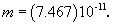
|
The total potential energy P M of the molecular configuration is, approximately,
| (6.20) | 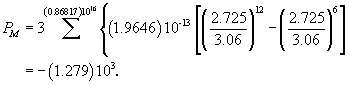
|
In order to determine the kinetic energy K M of the molecular system, we now fix the temperature at 15 C, at which temperature the modal speed of a water molecule is 3.65 /ps, or, equivalently, 3.65(10) 4 cm/sec. Hence, the kinetic energy of the molecular system is
Thus, from (6.20), the total energy E M of the molecular system is


 TABLE OF CONTENTS