Molecular and Particle Modelling of Laminar and Turbulent Flows

We now allow the 3500 particles to find their own equilibrium when interacting in accordance with (6.27). Initially, we choose ? T = 0.0001 and use the usual reflection protocol.
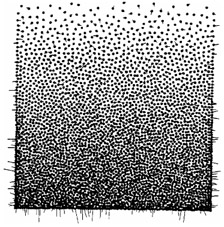
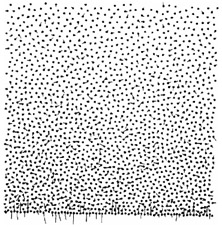
The initial motion of the system is almost one of free fall. So, for the first 7700000 steps, the velocity of each particle was damped at each time step by the factor 0.6. For the next five sets of 350000 time steps, the damping factor was changed, respectively, to 0.9, 0.95, 0.98, 0.995, and 0.999. For a final 350000 time steps, the damping was removed. The resulting stable configuration is shown in Fig. 6.25. From Fig. 6.25 we now extract the relatively dense set of 1718 particles in range -0.125 ? x ? 0.125, 0 ? y ? 0.25, shown in Fig. 6.26. This eliminates the surface tension particles at the top of Fig. 6.25, which are of no consequence, since these particles play no role in the cavity problem.