6.7. A Speculative Study of Liquid Water
In Sections 6.1 6.5, a particle mechanics approach was applied to study turbulence for water vapor in the context of the classical cavity problem. The primary aim was to develop a mechanism for turbulence. The primary aim now is to develop a turbulence mechanism in the large for liquid water, with the knowledge that no accurate Lennard-Jones potential is known for liquid water.
Let us choose first an approximate Lennard-Jones potential for water molecules. We choose the very same formula as for water vapor, that is,
| (6.12) | 
|
in which r ij is measured in angstroms ( ). This choice is, of course, incorrect. We will however explore what results can still be obtained from use of this formula which neglects the hydrogen bonding of close water molecules. It should be observed also that there is no clear delination between dense water vapor and liquid water.
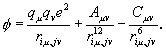
Note that our choice seems to be neither more nor less correct than potentials assumed by others. Rapaport's (1995) selection is the TIP4P potential, which has the form
In this potential, no constants are specified. Indeed, as stated by Rapaport: "The charges associated with the sites, while maintaining some resemblance to the actual molecule, are generally regarded as parameters that can be adjusted to fit known molecular properties ..." In the Rahman and Stillinger references (1971, 1974), pointed to by Rapaport, the following unusual way is made to determine the Lennard-Jones portion of their potential. In...


 TABLE OF CONTENTS