Measurement systems of one kind or another are as old as recorded history. In this book we deal with basic electrical/electronic units of measurement. We measure and explain the fundamental units volt, ohm, ampere of course, but we also discuss other units that are applicable to electrical and electronic technologies, namely, frequency, time, henries, farads, and impedance. Before you can begin to measure, you must first understand the meanings of measurement vocabulary terms or terminology. They are the subject of this unit. It's important that you understand the material in this chapter completely, because the language defined in it will occur throughout this text.
ACCURACY AND PRECISION
There is no such thing as an absolutely accurate measurement. All measurements are approximations of the "true" value. Thus, when the accuracy of a measurement or set of measurements is stated, it is always stated in terms of inaccuracy or a range around the true measurement in which the given measurement may be found. Accuracy, precision, and resolution are terms associated with measurement. Many other terms are used to describe measurement conditions, but these three are components of every measurement, even simple measurements. As an example, consider the measurement of a simple line segment, as in Figure 2-1.
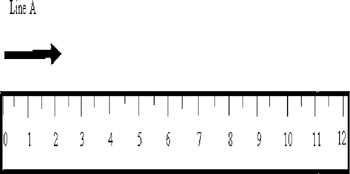 Figure 2-1: Ruler scale.
 Accuracy is how closely you approximate the true value. The measurement shown in Figure 2-1 falls between 2" and 2 ". If the desired accuracy was "to the nearest inch," then this would be an accurate estimate. However, if...
Copyright ISA—Instrumentation, Systems, and Automation Society 2006 under license agreement with Books24x7


 TABLE OF CONTENTS