Basic Electricity and Electronics for Control: Fundamentals and Applications, 3rd Edition

Digital logics are the building blocks of the digital revolution. From simple gates to highly complex application-specific integrated circuits (ASICs), digital logic is found everywhere. While this chapter is not a comprehensive review of all current digital logic (that would take several volumes), it will introduce you to various logic families and functions.
All digital circuitry consists of combinations of ANDs, ORs, XORs, NEGATEs, NORs, NANDs, counters, registers, and memory. In the beginning, logics were manufactured out of discrete components. This gave way to small-scale integration (SSI) and very quickly into large-scale integration (LSI). Today, a central processing unit (CPU) (microprocessor) is made up of millions of gates, registers, and counters.
To gain an understanding of digital logic a good place to start is with the gate circuits.
There are but four basic gate structures, just four. Complex logic is built out of various combinations of these gates. They are quite simple to understand. While all the gates discussed here have just two inputs, understand that gates may have many more than two inputs. The logic is the same.
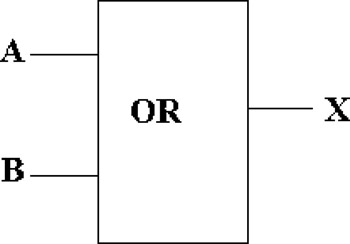
The rule for the OR gate is simple. A 1 on any input will give a 1 on the output. Referring to a two-input OR gate, the rule reads, "A 1 on input A OR a 1 on input B will cause the output to be a 1." Figure 17-1 illustrates the OR symbol, and Figure 17-2 shows a map of the logic.